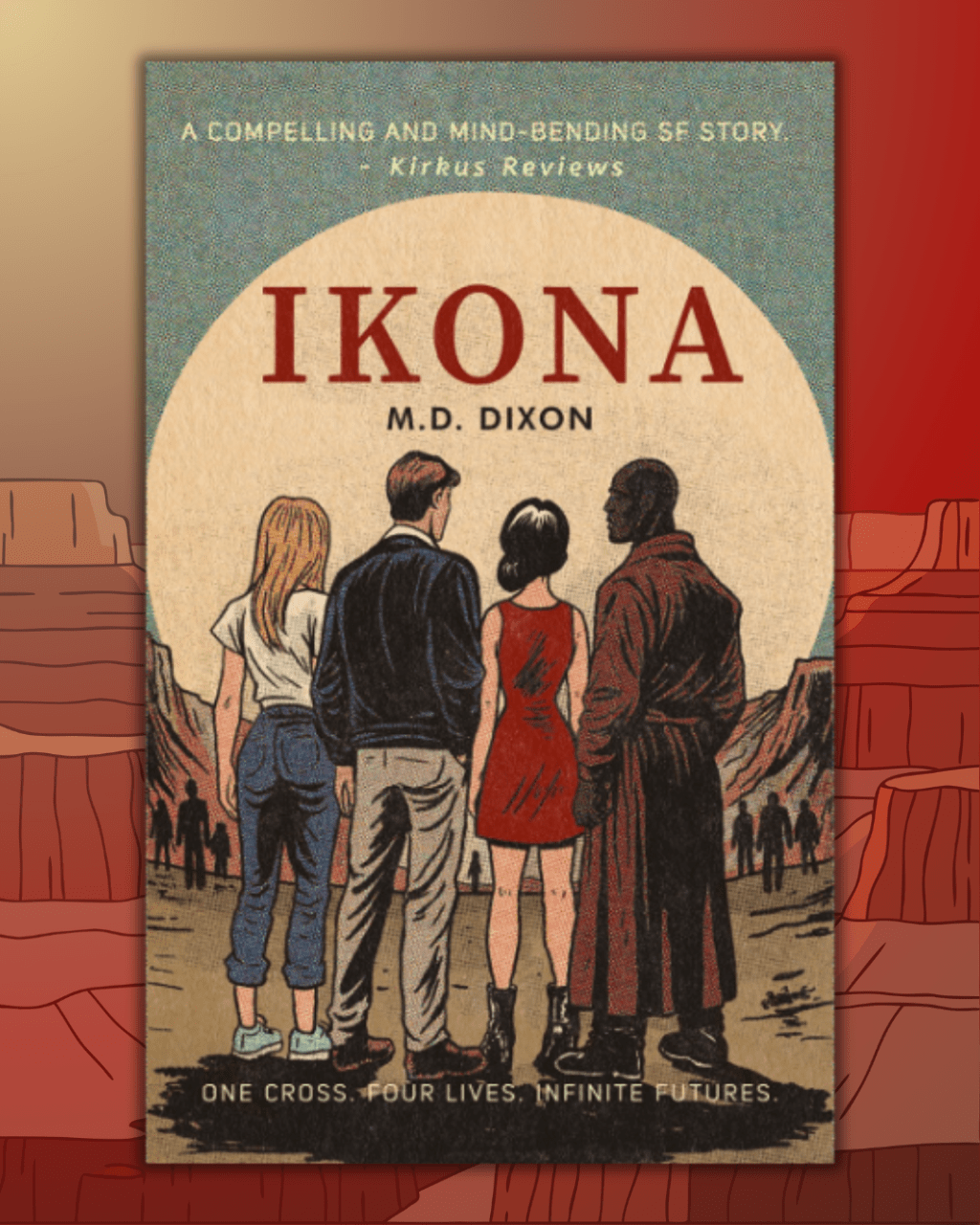

BLOG TOUR: Ikona by M.D. Dixon
Amazon: https://bit.ly/3ZdHSXy
Goodreads: https://www.goodreads.com/book/show/243253546-ikona
A visionary story of inner reckonings, IKONA by M.D. Dixon follows the re-emergence of an ancient icon that possesses the power to heal. As the artifact surfaces across different centuries and continents, it brings together individuals who must navigate the shifting realities of their world. The narrative focuses on the themes of memory, choice, and the fluid nature of time.
From the bustle of Sydney, Hong Kong, Atlanta, and Berlin to the quiet of a post-apocalyptic Siberian tundra, a mysterious Russian Orthodox cross begins to surface. This holy icon, endowed with an inexplicable healing power, draws four strangers into its field across different lifetimes and fractured timelines. In Atlanta, Kate Davies sees the cross heal a sick child, while in Sydney, Finley Minor is haunted by the consequences of possible futures. Jia Li MacPherson, a former thief and Shibari performer, holds secrets that others would kill to possess. Wallace Deng Moroz, a monk living a century in the future, searches for a cure in a world nearly destroyed by a genetic engineering catastrophe.
In a landscape of dangerous political polarization, their convergence feels destined, yet it is shaped by their own decisions. As they move closer to the cross’s resonance, they must determine which version of the future they will choose to inhabit and what they must surrender to reach it.
EXCERPT
1
———
FINLEY & THE SEA
MAY 2019
SYDNEY, AUSTRALIA
Finley Minor was by his own accounts an empty man, a listless man, spiritually and emotionally sparse. Blink a thousand times and his course in life would not have shifted an inch. He was motionless like a chameleon in the presence of a threat. But this was not fact, only fear, and that of a man who knew that he’d not lived at full throttle and had succumbed to the fate of it —a slow and shallow life. He ruminated on it. He judged himself for it. He laughed at his own expense, without thinking he might ever change a thing.
In the way one always has a beginning, a great excuse, this was Finley’s: at the age of seven, in his native England, he sat on the beach as his stick wove tessellations in the sand (almost of its own accord, it seemed in retrospect), and he looked to the horizon towards France with the open, impressionable curiosity of his young age. He wondered at the sea’s depth, its great distance, how one might (as many had) swim across the channel, what creatures might lurk there, what they might feel like against bare skin. He imagined something slimy and cold, fanged, and slithering. The waves seemed to roar at him, even though they descended in the rockpools with the gentleness of pooling cream.
He stood, determined to satisfy his curiosity. He took halting steps over the rocks and shells, straight ahead, then bearing left around a rock face that jutted into the sea. He sat on a big, flat rock and stared into the gray water. He heard his father calling out his name, but ignored him. The water rushed in again and again, and each time reached further and further, first sucking at his toes, then his heels, then his knees. His curiosity fled; he became afraid, and all sound was magnified, the dull ocean roar, the seagull squawking a few feet away, his heartbeat. He knew he had to go back to shore. He waved to his father, stood, and took a faltering step. There was a low murmur; the water fizzled once more in retreat from the rocky sand like the gasping breath of a dying man. He felt dizzy and fell to his knees. He crouched on all fours and steadied himself as the water swirled and grasped at him, and the sky looped and the clouds fell from the corner of his eyes. He felt his head winched back towards the horizon, and the sea reached for his throat. Blackness.
When he came to, dragged back to shore by his father, he announced that his aunt would never return from her Côte D’Azur holiday. He wagged his finger towards the surf and pulled a face, “Over there, there is smooching.”
The official prognosis was that he’d had an epileptic fit, though none of the tests proved it. He must have passed out, in that case, the doctor pronounced, low blood sugar, a low-level virus, dehydration.
But Finley knew, only he knew.
The ocean had rent a hole in his soul, and let in the future.
Q & A with the Author
What’s a detail, theme, or clue in your book that most readers might miss on the first read—but you secretly hope someone notices?
I hope someone notices that whilst the present-day chapters and future chapters are chronologically ordered forward in time, the chapters set in the past (early 20th century Siberia) move backwards in time, so that the earliest chapter timeline-wise for the past chapters reaches a climax at the latest period time-wise for the other chapters. Truthfully, there are many other details that might be missed but which astute readers will catch: recurring motifs, the recursive nature of the story, how Gutov’s chapter 26 is also IKONA’s chapter 26, for example.
When did this story or idea “click” into place for you—was there a single moment you knew you had to write it?
This story first came to me in 2012. I planned the structure and journeys for years before I sat down to write it. I knew from the moment I got the first few pages and the title that it would be my most mature work. It is my fourth novel, but my first published novel. It was a persistent inner voice which never left me no matter how many twists and turns my life took in the interim. I wrote it in 2022.
Which character or real-life person surprised you the most while writing this book, and why?
Finley Minor’s journey evolved in a way I didn’t expect. No spoilers so I will just say that his arc deeply moved me, and I was unprepared for my own emotional reaction.
If your book had a soundtrack, what three songs would be on it and what scenes or moments would they pair with?
Jimi Hendrix’s All Along the Watchtower was a song that appeared in my mind the moment the title and first chapter appeared, as if guiding me with its revolutionary message – I feel that this song is the musical equivalent of IKONA’s message.
The song You Are a Memory by Message to Bears accompanied Part Three of the novel and always brings me back, emotionally, to Finley’s and Wallace’s final chapters.
Saeglopur by Sigur Ros takes me to the narrative’s climax and particularly Jia Li during one of her Shibari performances.
Music was a salve for the entire writing of IKONA and I created a public Spotify playlist for the novel called IKONA the Playlist.
What’s one belief, question, or emotional truth you hope readers carry with them long after they finish your book?
Hope. I want readers to experience hope and a sense of personal agency in the long road of societal change we currently find ourselves navigating.
Tell us about a moment during the writing process when the story (or message) took an unexpected turn.
Honestly, writing this felt like an experience of transmission. There was no unexpected turn – the consistency in message, tone and narrative arc was set and unwavering. There was always a sense of consistency, as if the river of words flowed, and I was merely the faithful witness. From a craft point of view, there was a fair bit of planning. It felt like a giant puzzle I had to arrange in precisely the correct order. Like sacred geometry. Which chapters went where, and in what order, and so on. But the narrative itself flowed without deviation.
If your protagonist (or the central figure in your nonfiction) could give the reader one piece of advice, what would it be?
Well, as my character Gutov says regarding his chapter the Bridge, “Read it again, this time with your heart.”
What real-world place, object, or memory helped shape a key element in your book?
I am a Russophile by training, albeit 30 years ago. I lived in St. Petersburg, did my doctoral research in Crimea, travelled a lot in Russia and Ukraine…
My experience speaking Russian with friends, speaking of the soul, of life, of destiny, on -35 degree nights in friends’ apartments, with vodka or strong coffee, has certainly shaped me, and by extension, my vision and prose. This was in the 1990s, a time of that society’s collapse – the atmosphere and weight of it permeates my marrow. So this definitely has shaped a certain ‘vibe’ of IKONA.
What’s something you had to research, learn, or experience to write this book that genuinely shocked you?
I can’t speak to shock; I don’t think anything shocked me! But I did a deep dive on the process of creating a metal crucifix –the how tos – and this led me to researching the life of iconographers in early 20th century Russia, and that was fascinating. I found a wonderful academic book on the subject matter with loads of photos, and it just really touched me. Iconographers were like monks, and lived as such and were part of the monastic community. I loved how when they created icons, it was a holy occasion accompanied by fasting and prayer.
SPOILER ALERT: I was surprised (and also not surprised as I know Russians and Russian history) that one of the chief investigators of the Tunguska Event was a famous (at the time) science fantasy author. The government actually invited this person to research and comment, because conventional science had found no answers, but they thought this author had some kind of insight into the field of reality beyond hard science. It always makes me chuckle when I remember this.
If your book were invited to join a shelf with three other titles, which ones would make you happiest—and what would that shelf say about your story?
I would place it alongside Cloud Atlas by David Mitchell, The Teachings of Don Juan by Carlos Castaneda, and The Overstory by Richard Powers. I think because it signals to the reader that while the story is a high-concept, multi-timeline puzzle, it is grounded in the visceral, feet-on-the-ground reality of a spiritual initiation. This shelf tells the reader that IKONA is an invitation to look beyond the shadows of our current reality and contemplate how consciousness itself can heal the future.
About the Author:
M.D. Dixon is a novelist, somatic therapist, and explorer of the intersections between the psyche and the sacred, science and mysticism, trauma and transformation. Holding a Ph.D. in the social sciences with a focus on Russia and Ukraine, Dixon has spent nearly fifteen years in therapeutic practice in Sydney, Australia. Dixon’s debut novel, IKONA, weaves visionary fiction, myth, and metaphysics to illuminate the evolution of consciousness. Dixon also hosts The Shattering Place, a podcast on multidimensional healing and the awakening human story, launching in early 2026.
Visit M.D. Dixon online.
 CC Belle